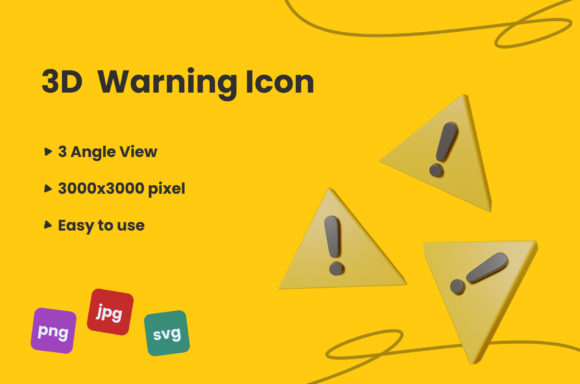
3D Warning Icon
We have all seen them. That bright yellow triangle with the exclamation mark inside, usually sitting quietly in the corner of a screen or printed on a safety sign. It is one of the most universally recognized symbols in human communication. But when you are designing digital interfaces, creating educational materials, or building a brand identity, a flat, two-dimensional icon can sometimes feel a bit... flat. It lacks presence. This is where the 3D Warning Icon steps in, transforming a simple alert into a visual cue that demands attention without being aggressive.
If you are looking to download high-quality assets for your next project, specifically a 3D Warning Icon available in multiple formats like JPG, PNG, and SVG at a robust 3000×3000 pixel resolution, you are likely thinking about how this asset will perform across different mediums. Whether you are a freelancer crafting a user interface, an educator preparing a safety guide for students, or a small business owner updating your website, understanding the nuances of using 3D warning graphics can significantly improve the clarity and professionalism of your work.
Why Choose a 3D Representation?
In a world saturated with information, standing out requires more than just color; it requires depth. A standard 2D icon is functional, but a 3D rendered version adds a layer of tactile realism. When users see a 3D warning icon, their brains process it differently. The shadows, highlights, and perspective cues suggest physicality. It feels like something you could pick up, which subconsciously increases its perceived importance.
This is particularly useful in UI/UX design. When a user encounters a critical error message or a security alert, a subtle 3D effect can make the notification feel more "solid" and urgent, encouraging immediate action without causing anxiety. It bridges the gap between sterile data and human interaction.
Real-World Applications Across Industries
The versatility of a high-resolution 3D warning graphic means it can be deployed in numerous scenarios. Let’s look at how different professionals might utilize this specific asset.
Digital Product Design and Web Development
For web designers and app developers, clarity is king. If you are building a dashboard for a financial application, a warning about unusual activity needs to be noticed instantly. A 3D Warning Icon downloaded as an SVG file ensures that no matter how much the user zooms in or resizes the browser window, the edges remain crisp. At 3000×3000 pixels, you have plenty of room to scale down for mobile views while retaining the intricate details that give it that premium 3D look. This scalability is crucial for maintaining a consistent brand aesthetic across desktop, tablet, and mobile devices.
Educational Materials and Safety Training
Teachers and corporate trainers often struggle to keep audiences engaged. Text-heavy safety manuals are easily ignored. However, incorporating vibrant, realistic 3D icons into slide decks, handouts, or online courses can break up the monotony. Imagine a module on workplace safety where each hazard—electrical, chemical, mechanical—is represented by a distinct, high-quality 3D warning symbol. These visuals act as anchors for memory. Students are more likely to remember the concept associated with a striking image than a bullet point. Because the file is available in both JPG and PNG, you can easily embed these images into PowerPoint presentations or PDF guides without worrying about complex vector editing software.
Marketing and Social Media Content
Content creators and marketers know that stop-scrolling power is everything. On platforms like Instagram, LinkedIn, or Twitter, a well-designed graphic can halt a user’s feed. Using a 3D warning icon as part of a "Did You Know?" post, a limited-time offer alert, or a cybersecurity awareness campaign adds a professional polish. The high resolution (3000×3000) allows you to crop tightly around the icon for social media thumbnails, ensuring it remains legible even on small smartphone screens. The transparency offered by the PNG format is especially handy here, allowing you to place the warning icon over any background color or pattern without a clunky white box surrounding it.
Small Business and E-commerce
If you run an online store, trust signals are vital. Adding a 3D warning icon near payment gateways or shipping policies can subtly reassure customers that their data is protected or that there are important terms they should review. It adds a touch of sophistication to your site’s infrastructure pages, making them feel less like legal jargon and more like helpful guidance.
Technical Considerations: Choosing the Right Format
Having access to the same design in JPG, PNG, and SVG formats is a significant advantage, but it also requires some decision-making. Here is how to choose the right file type for your specific need.
- SVG (Scalable Vector Graphics): This is your go-to for web development and print projects requiring infinite scalability. Since the 3D Warning Icon is provided in SVG, you can animate it, change its colors via CSS, and ensure it looks sharp on retina displays. It keeps your file sizes small while maintaining quality at 3000×3000 pixels.
- PNG (Portable Network Graphics): Use this when you need transparency. If you are placing the icon over a busy background image or a gradient, the PNG format preserves the alpha channel, letting the background show through. It is ideal for presentations, documents, and social media posts where you don’t need to edit the geometry of the icon later.
- JPG (Joint Photographic Experts Group): While JPG does not support transparency, it is excellent for photographs or complex gradients. If your 3D warning icon has very complex lighting effects that might bloat an SVG file, or if you simply need a quick, compressed image for a blog post header, JPG is a reliable choice. Just be mindful of compression artifacts if you plan to zoom in closely.
Best Practices for Implementation
Downloading the asset is only half the battle. How you use it determines its effectiveness. First, consider context. A warning icon should never be used decoratively without purpose. Overusing alerts leads to "alert fatigue," where users start ignoring them entirely. Reserve the 3D Warning Icon for genuine cautions, errors, or important notices.
Second, pay attention to contrast. Even the best 3D render will fail if it blends into its background. Ensure there is sufficient contrast between the icon and its surroundings. If you are using the PNG version, test it against both light and dark modes of your application to ensure visibility.
Third, maintain consistency. If you use a 3D style for warnings, try to use similar 3D styles for other icons in your set. Mixing hyper-realistic 3D icons with flat, minimalist line art can create a disjointed user experience. The goal is to create a cohesive visual language that guides the user intuitively.
Final Thoughts on Asset Quality
The difference between a generic clip-art warning sign and a professionally rendered 3D icon is night and day. The latter conveys effort, care, and attention to detail. By choosing a high-quality source like Silenic Co., you are investing in the perception of your own work. The fact that these files are available in such high resolutions (3000×3000 pixels) gives you the freedom to experiment. You can create large banners, detailed infographics, or crisp mobile assets from the same source file.
Whether you are designing a new app, updating your company’s safety protocols, or just trying to make your blog posts pop, the right visual tools make a tangible difference. A 3D Warning Icon is more than just a shape; it is a communication tool that, when used correctly, enhances clarity and engagement. Take the time to explore the different formats, understand where they fit best in your workflow, and watch how your designs come to life with added depth and impact.