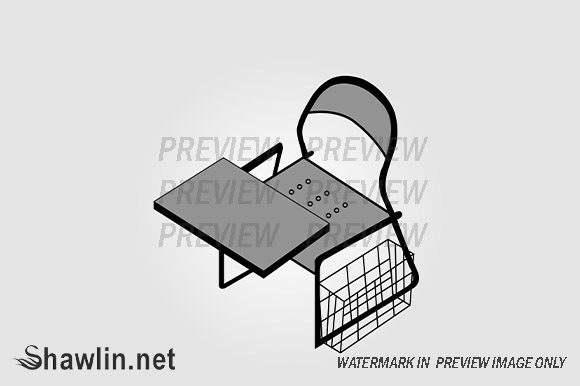
Evaluating the 3D or Isometric View of Table for Modern Design Projects
In the realm of digital illustration and graphic design, visual clarity often hinges on perspective. Among the various stylistic choices available to designers, the 3d or Isometric View of Table has emerged as a versatile and highly functional aesthetic. This style offers a unique balance between technical precision and artistic appeal, making it a popular choice for everything from user interface (UI) elements to editorial illustrations. For professionals evaluating this asset type, understanding its structural nuances, file formats, and practical applications is essential before integrating it into a workflow.
The core appeal of an isometric table illustration lies in its geometric consistency. Unlike traditional one-point or two-point perspective, which relies on vanishing points to create depth, isometric projection uses parallel lines that never converge. This creates a sense of three-dimensional space without the distortion associated with standard perspective. When applied to a table—a fundamental object in both domestic and professional settings—this technique allows designers to showcase surface details, structural integrity, and spatial relationships simultaneously. The result is a clean, organized look that communicates functionality while maintaining visual interest.
Distinguishing Features of the Isometric Table Aesthetic
What makes the 3d or Isometric View of Table distinct from other 3D rendering styles is its adherence to strict mathematical rules regarding angles and scale. In a true isometric view, the axes are typically spaced at 120-degree intervals, and measurements along these axes are scaled equally. This uniformity provides several advantages for designers:
- Predictable Scaling: Because there is no foreshortening, objects placed within the scene maintain their relative proportions. This makes it easier to arrange multiple items on a table surface without worrying about them appearing unnaturally stretched or compressed.
- Clean Geometry: The absence of curved perspective lines results in sharp, crisp edges. This aligns well with modern flat design trends and minimalist aesthetics, allowing the illustration to blend seamlessly into contemporary web and app interfaces.
- Layered Depth: Despite being "flat" in terms of vector construction, the isometric view effectively conveys depth. Designers can stack items on the table—such as laptops, coffee cups, or documents—and clearly see their top and side profiles, enhancing the narrative of the scene.
For many users, the decision to use an isometric table involves comparing it against photorealistic 3D renders. While photorealism offers texture and lighting realism, it often requires significant processing power and time to render correctly. In contrast, an isometric vector approach offers scalability and ease of editing. A designer can easily change the color of the table legs or swap out the items on the desktop without re-rendering the entire image. This flexibility is particularly valuable in agile design environments where rapid iteration is required.
Technical Considerations: File Formats and Accessibility
When sourcing assets for a project, the technical specifications of the file are just as important as the visual style. High-quality illustrations should be delivered in formats that support both scalability and broad compatibility. A robust package for a 3d or Isometric View of Table typically includes vector files, such as EPS or AI formats, alongside high-resolution raster options like JPG or PNG.
The inclusion of Vector EPS files is a critical feature for professional workflows. Vectors allow designers to resize the illustration to any dimension without losing quality, ensuring that the table looks sharp whether it is displayed on a mobile screen or printed on a large banner. However, software versioning can sometimes pose a challenge. Older versions of design software may struggle to open files created in newer iterations of Adobe Illustrator or similar programs. Therefore, it is prudent to check if the asset provider includes backward-compatible versions. Some packages explicitly state that they contain the illustration in Vector EPS format compatible with older software versions, ensuring that users do not encounter opening errors due to version mismatches.
Additionally, the availability of a high-resolution JPG format zipped together with the vector files adds convenience for quick previews or non-editable usage scenarios. This dual-format approach caters to a wider range of users, from those who need to manipulate individual layers to those who simply need a static image for immediate deployment. It is also worth noting that legitimate professional assets should be free of watermarks in the final deliverables. Watermarks are typically reserved for preview images to protect intellectual property, but the downloaded files should be clean and ready for commercial use. Always verify this detail before purchasing or downloading to avoid unexpected licensing issues.
Comparing Isometric Tables with Alternative Visual Styles
To make an informed decision, it helps to compare the isometric table against other common visual approaches. One alternative is the Top-Down Flat Lay. While flat lays offer a clear view of the table's surface, they lack the sense of volume and immersion that isometric views provide. An isometric table feels more "present" in the space, whereas a flat lay can feel more like a diagram or a schematic. If the goal is to evoke a cozy, lived-in atmosphere, isometric might be preferable; if the goal is pure data visualization or inventory listing, flat lay may suffice.
Another comparison point is Realistic 3D Rendering. Realistic renders excel in conveying material properties—such as the grain of wood or the reflection on glass. However, they often come with heavier file sizes and less editability. An isometric vector table is lighter, faster to load on websites, and easier to customize. For projects where brand colors need to be updated frequently, the vector-based isometric approach is far more efficient. Furthermore, isometric illustrations tend to age better stylistically than hyper-realistic renders, which can quickly look dated as rendering technology evolves.
A third option is Schematic or Wireframe Views. These are useful for technical documentation but often lack the visual polish required for marketing materials or user-facing interfaces. The 3d or Isometric View of Table strikes a middle ground, offering enough detail to be engaging while remaining abstract enough to serve as a flexible background element.
Best-Fit Situations and Decision Factors
Choosing the right visual asset depends heavily on the context of the project. The isometric table is particularly well-suited for:
- Tech and SaaS Interfaces: Dashboards and landing pages often use isometric scenes to depict productivity, collaboration, or workspace organization. The clean lines complement the structured nature of software interfaces.
- Educational Materials: Infographics explaining processes or showing how components fit together benefit from the clear spatial representation of isometric views.
- Furniture and Interior Design Marketing: While realistic photos show the actual product, isometric illustrations can be used to conceptualize layouts or show different configuration options without needing physical prototypes.
However, there are limitations. If the project requires conveying specific textures, lighting conditions, or emotional warmth, an isometric vector may fall short. In such cases, a photograph or a detailed 3D render would be more appropriate. Additionally, overuse of isometric elements can lead to visual fatigue, as the rigid geometry can feel repetitive. Designers should use these assets strategically to highlight key information rather than filling every corner of a layout.
Customization and Future-Proofing
One of the strongest arguments for using stock or template-based isometric assets is the potential for customization. Many providers offer contact forms or custom request options for clients who need specific modifications. Whether it involves changing the table material, adjusting the angle slightly, or adding specific branded items to the tabletop, direct communication with the creator can yield a tailored solution. This level of service ensures that the asset fits the unique needs of the project without compromising the overall aesthetic integrity.
Ultimately, the 3d or Isometric View of Table represents a smart compromise between artistic expression and technical utility. Its geometric clarity, scalability, and adaptability make it a valuable tool in a designer’s arsenal. By carefully evaluating file formats, understanding its strengths relative to other styles, and considering the specific goals of the project, designers can leverage this asset type to create compelling, professional, and effective visual communications. Whether used in a startup pitch deck, a corporate website, or an educational module, the isometric table provides a reliable foundation for storytelling through design.